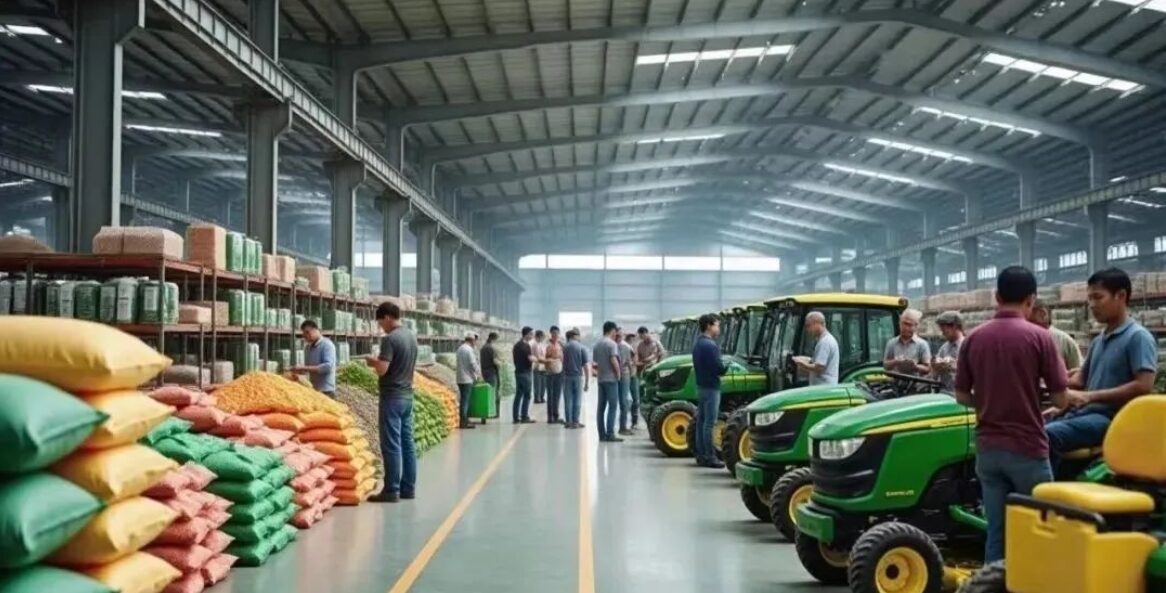
In a move that could redefine China’s agricultural inputs sector, Shandong Province unveiled the Qilu Farming Agricultural Service Supermarket, a 15,000-square-meter retail giant shaking up traditional distribution models and setting a new benchmark for agribusiness retailing in China. Equivalent to 2.5 standard football fields, this state-backed megastore is the largest single-location agri-retail facility in China’s agricultural inputs industry. However, beyond its size lies a revolutionary approach to supply chain efficiency, product diversity, and farmer empowerment. This approach has the potential to reshape the $80 billion domestic market within the decade.
Unprecedented Scale and Innovation
At its core, Qilu Farming’s design challenges traditional retail models. Divided into strategic zones — 40% for bulk commodities, 20% for precision agriculture demonstrations, 15% for technical services, and 25% for logistics — the supermarket provides farmers with an integrated ecosystem. Products range from conventional and specialty fertilizers, pesticides, seeds, and agricultural films to machinery and smart farming solutions. The direct factory procurement model eliminates four to five traditional distribution layers, reducing markups by 30 to 60 percent compared to conventional channels. This translates into substantial cost savings for farmers—up to RMB 150–300 per ton of fertilizer—while ensuring quality through direct factory sourcing. The store boasts over 5,000 SKUs, in stark contrast to the 200–300 SKUs offered by traditional channels.
Disrupting the Status Quo: By the Numbers
The mega-store’s impact is most acutely felt in its dismantling of traditional distribution hierarchies. While traditional channels rely on a four- to five-layer system (national → local), Qilu Farming’s “factory → farm” model streamlines logistics. This reduces average markups from 80–120% to 15–30% and increases product variety tenfold. Furthermore, Qilu Farming’s digital infrastructure, which includes IoT-enabled inventory management, a mobile app for ordering, and VR product demonstrations, aligns with China’s push for digital agriculture. On-site agronomists and regular training sessions address a critical gap in technical support, a weakness of smaller retailers. Price transparency is achieved through digital tags, a significant improvement over the opacity of traditional channels.
Policy Support and Strategic Implications
Qilu Farming receives provincial-level policy support and is integrated into rural service networks, backed by major organizations such as the All-China Federation of Supply and Marketing Cooperatives, the Shandong Supply and Marketing Cooperative, and the Anqiu Municipal Government. This institutional support ensures quality control and aligns with China’s “rural revitalization” strategy, which aims to modernize agriculture and reduce disparities between rural and urban areas. As a result, this model could prompt significant industry changes. County-level distributors may become obsolete, accelerating consolidation among small retailers and paving the way for regional mega-stores. The model’s success could reshape the $80 billion domestic agri-inputs market, which is currently dominated by fragmented channels with limited efficiency and transparency.
Targeted Customer Benefits: Empowering Farmers
Qilu Farming’s model directly addresses the challenges that farmers in China face:
- Cost savings: Reduced prices through streamlined supply chains.
- Quality assurance: Guaranteed authenticity through direct factory sourcing.
- One-Stop Solution: Access all the necessary resources (from seeds to machinery) and services (from technical training to logistics) in one place.
- Knowledge Transfer: On-site experts and training sessions enhance farmers’ technical capabilities.
These benefits align with China’s goal of increasing agricultural productivity and profitability, particularly for small-scale farmers who often lack access to modern resources.
Challenges and the Road Ahead
Despite its promise, Qilu Farming faces challenges. Serving dispersed smallholders poses logistical challenges, and maintaining cash flow under thin margins at scale requires careful management. Overcoming farmers’ entrenched procurement habits and building trust in this new model are also critical. As one industry analyst notes, “The true test won’t be its size, but whether it can deliver cheaper, better, and more convenient solutions than existing channels in a sustainable way.” Future plans include national expansion, with the goal of establishing 20+ facilities by 2030, as well as service integration, which includes adding financial and insurance products, and deeper tech adoption, such as using blockchain technology to ensure supply chain transparency. These advancements establish Qilu Farming as a leader in China’s agricultural retail transformation, signaling an irreversible shift toward consolidated, tech-driven efficiency.
Conclusion
The Qilu Farming Agricultural Service Supermarket embodies China’s ambition to modernize its agricultural inputs sector through scale, technology, and policy synergy. By eliminating traditional distribution barriers, providing one-stop solutions, and digitizing the supply chain, Qilu Farming represents a radical departure from the status quo. Although challenges remain, its potential to reshape the $80 billion industry and empower farmers through cost savings and knowledge transfer makes Qilu Farming a pivotal experiment in China’s rural revitalization strategy. As the first of potentially many such megastores, Qilu Farming may well become the blueprint for the future of agribusiness retail in China and beyond.