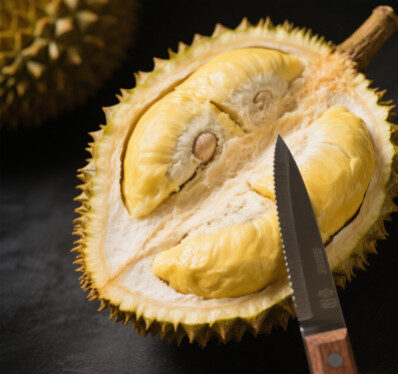
The global durian market is currently experiencing intense competition. Vietnam is challenging Thailand’s long-standing dominance by employing innovative farming techniques and off-season production. Meanwhile, Cambodia is emerging as a new threat, rapidly expanding its cultivation area. This battle for market share, particularly in China—the largest consumer of durians—is reshaping the dynamics of the global durian trade.
Vietnam’s Strategic Shift: Precision Farming and Off-Season Production
The country has made significant strides in the durian market by adopting precision farming techniques and restructuring its supply chain. At a recent workshop in Can Tho City, agricultural experts and industry leaders discussed the country’s strategic focus on high-quality export solutions. Nguyen Van Su, chairman of the Can Tho City Farmers’ Association, emphasized the economic significance of durians in the Mekong Delta region, particularly since China began importing Vietnamese durians in 2022.
However, Vietnam faces several challenges, including China’s strict plant quarantine, food safety, and cadmium residue level requirements. In order to meet these standards, the country must improve its production systems, implement traceability measures, and adopt good agricultural practices (GAP) and integrated pest management (IPM) strategies.
One of Vietnam’s key advantages is its ability to produce durians out of season. Tran Van Hau, an honorary professor at Can Tho University, explained that the country’s diverse climate enables technological intervention to control flowering and harvesting periods. This enables Vietnam to supply durians during the market gap from November to March, when prices are significantly higher. This strategic advantage helps Vietnam capture a larger share of the lucrative Chinese market.
The Rise of Cambodia: A New Player in the Durian Market
While Vietnam and Thailand currently dominate, Cambodia is emerging as a formidable competitor. With lower labor costs and a cultivation area that has grown by 400% over the past three years, Cambodia is poised to shake up the market. In April 2025, Cambodia signed a phytosanitary protocol with China, paving the way for fresh durian exports by the end of the year.
The country’s unique Au Khak durian variety, primarily cultivated in the provinces of Kampot and Kampong Cham, has attracted the interest of Chinese consumers. Thanks to the Cambodia-China Free Trade Agreement and the Regional Comprehensive Economic Partnership (RCEP), Cambodian durians enjoy zero-tariff treatment and faster quarantine channels, enhancing their competitiveness.
China: The Ultimate Battleground
China remains the primary market for durian exporters. In 2024, Thailand exported 833,000 tons of durians to China, capturing 52% of the market share. Meanwhile, Vietnam shipped 736,700 tons, accounting for 46%. However, during the first half of 2025, Thailand’s exports increased to 550,000 tons, valued at $2.5 billion. This surge captured 77% of the market, while Vietnam’s share decreased to 22%.
Cambodia’s entry into the Chinese market is expected to intensify competition further. With its favorable trade agreements and lower production costs, Cambodia could compete with Thailand and Vietnam for market dominance.
Challenges and Opportunities Ahead
To meet China’s strict requirements, Vietnam’s durian industry must improve its scientific farming methods, organic production, and chemical management practices. Experts urge the government to develop comprehensive land-use maps, strategies for safe water and fertilization, and stronger monitoring of planting areas to ensure transparent traceability.
Meanwhile, Cambodia faces the challenge of building brand recognition compared to well-known varieties like Thailand’s Golden Pillow and Malaysia’s Musang King. However, with increased investment and technical support, Cambodian durians could soon be competitive in terms of quality and price.
Conclusion
As the durian wars heat up, Vietnam’s off-season production strategies and Cambodia’s rapid rise are poised to transform the global durian trade. These developments offer consumers more choices while intensifying competition among producers. The future of the durian market depends on how each country navigates the evolving market landscape, particularly in China—the ultimate battleground for durian exporters.