
BEIJING, September 4, 2025 — China’s sulfuric acid market experienced a notable period of regional divergence in August, marked by varied price fluctuations and evolving supply and demand dynamics across major regions. In the south and east, prices surged due to robust demand from the agricultural sector and increased raw material costs. Conversely, provinces such as Shandong and Hubei witnessed price declines primarily due to oversupply and sluggish local consumption. This fragmentation reflects deeper structural differences in regional supply chains, cost structures, and downstream industry performance, indicating a complex outlook for September.
Key Trends and Regional Disparities
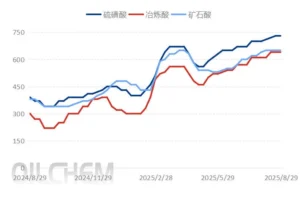
Sulfuric Acid Market in China Exhibits Intensified Regional Divergence in August: Complex Dynamics Shape September Outlook
1. Price Movements and Regional Dynamics
- Rising prices in South and East China: Supported by rising pyrite prices (a key raw material) and robust demand from phosphate fertilizers, acid producers in Guangdong (Yunfu) increased prices by RMB 30 per ton in early August. Similarly, stable outbound shipments and export orders buoyed prices in East China (Anhui and Jiangsu). Tight supply due to planned maintenance at acid plants in central China, Zhejiang, and Fujian exacerbated the upward price pressure.
- Price Pressures in Shandong and Hubei: Conversely, Shandong experienced significant supply increases as previously curtailed capacities resumed operations. Weak local demand, hindered northbound trade, and declining export orders (particularly from Jiaodong) forced producers to offer discounts. Prices fell by RMB 30–50/ton in Laiwu and central Shandong. In Hubei, rising operating rates at downstream sulfur-based acid units led to an inventory buildup. This prompted producers to cut prices by RMB 30–40/ton to alleviate pressure.
- Mixed Signals in Other Regions: Despite tight supply-demand imbalances in Chifeng and northeastern China, high prices began to strain downstream users, limiting further upward potential. Meanwhile, Yunnan, Zhejiang, western Inner Mongolia, and Guangxi benefited from seasonal fertilizer demand and plant maintenance, sustaining price hikes.
2. Supply-Side Contrasts and Operating Rates:
National Operating Rate Decline: The national operating rate of acid plants declined to 68.05% in the week ending August 29. This represents a 0.32% decrease from the previous week but a 0.99% increase from last year. Maintenance at sulfur-based acid plants in Jiangsu, production cuts in Shandong, and short-term shutdowns at major plants in Central China reduced supply. A copper smelter undergoing maintenance in Jilin, in northeastern China, also contributed to regional tightness.
Regional Supply Trends: While supply tightened in Central China and Zhejiang due to planned outages, revived capacities in Shandong offset this, creating a supply-demand mismatch. Industry forecasts predict the operating rate will drop further, to 67.95%, next week, which could stabilize supply in the short term.
3. Downstream Demand: A Tale of Two Sectors
- Phosphate Fertilizers (Key Driver): August saw robust growth in phosphate fertilizer production. Monoammonium phosphate (MAP) output reached 1.1368 million tons, up 7.67% month over month (MoM), with a utilization rate of 72.41%, up 4.89% MoM. Diammonium phosphate (DAP) production totaled 1.2724 million tons (up 3.43% MoM) with a utilization rate of 65.34% (up 2.17% MoM). This surge in fertilizer demand supported acid prices in Yunnan, Zhejiang, and Inner Mongolia.
- Mixed Performance in Other Sectors:
- Compound fertilizers: Production surged to 5.3133 million tons (up 25.87% month-over-month), with a utilization rate of 41.26% (up 8.48% month-over-month), indicating robust seasonal demand.
- Titanium dioxide (TiO₂): Domestic output increased 0.30% month-on-month (MoM) to 370,100 tons, though it remained 5.42% lower year-on-year (YoY), reflecting muted demand.
- Caprolactam: Production declined 1.95% month over month (MoM) to 582,600 tons, highlighting weakness in chemical segments.
Overall, while phosphate fertilizers showed resilience, non-fertilizer sectors (e.g., titanium dioxide, citric acid) faced challenges, creating demand asymmetry across regions.
Market Sentiment and September Outlook
A sentiment survey of market participants as of August 29, 2025, revealed mixed expectations.
- Bullish respondents (22%) expressed optimism centered on firm pyrite prices (which put upward pressure on production costs), ongoing plant maintenance (which creates supply constraints), and resilient phosphate demand, particularly in regions with tight inventories. The bullish outlook suggests that market participants expect these factors to support prices and potentially lead to increased market activity.
- Bearish (18%): Pessimism stems from concerns over exhaustion of export quotas, which may weaken demand after August, as well as uncertain non-fertilizer demand. Oversupply in regions such as Shandong and slowing downstream growth in titanium dioxide (TiO₂) were cited as risks. This bearish view indicates that participants are cautious about a potential decline in market activity due to these factors.
- Neutral/sideways (60%): The majority anticipate a range-bound market, balancing tight raw material supply and low acid plant operating rates against modest downstream consumption. Participants believe that prices will lack momentum until clearer demand signals emerge. The neutral stance suggests that the market may remain stable until more definitive trends in supply and demand emerge.
The disparity in expectations among market participants underscores the current market’s uncertainty and complexity. A bullish perspective could lead to increased investment and production, while a bearish view could result in more cautious strategies. Overall, the market appears to be waiting for clearer signals to determine its future direction.
Conclusion
China’s sulfuric acid market faces a multifaceted landscape in September. Regional dynamics will remain pivotal, with cost pressures, fertilizer demand, and supply adjustments influencing price fluctuations. While phosphate-driven demand offers support in certain regions, risks of oversupply and weak non-fertilizer sectors could limit upside potential. To navigate this period of uncertainty effectively, market participants are advised to monitor regional inventory levels, downstream production schedules (especially for fertilizers), export trends, and raw material costs. Key risks include oversupply and subdued demand from non-fertilizer industries. However, opportunities lie in robust phosphate-driven demand in some areas.
Sources: China Chemical Industry Association, enterprise production data, market sentiment survey (August 2025).