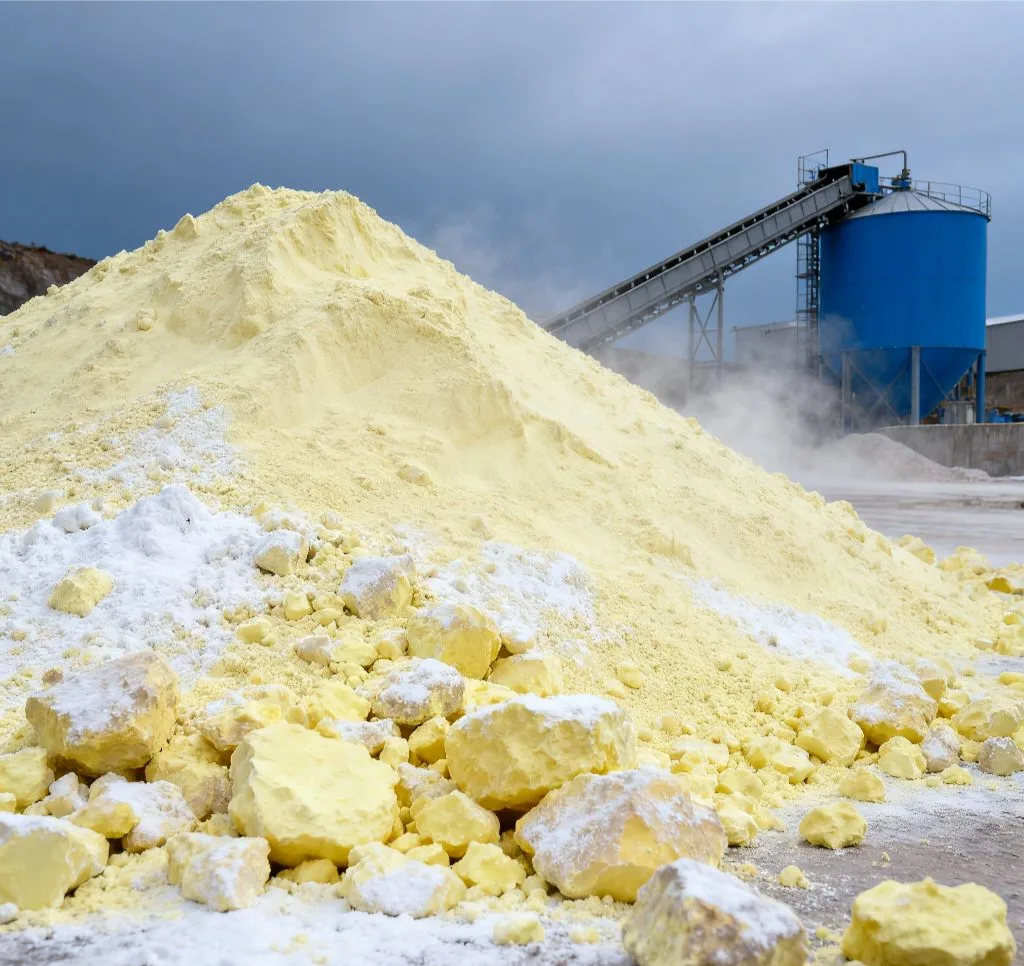
China’s phosphoammonium market is being swept into an unprecedented cost storm, triggered by the recent sharp rise in sulfur prices.
As of November 6, sulfur prices at Shandong ports reached RMB 3,561.16/ton, an increase of RMB 79.99 from the previous trading day. In North China, the mainstream price of solid sulfur has soared to RMB 3,050–3,140/ton.
This rapid surge has quickly swept through the entire phosphoammonium industry chain, leading to a sharp increase in production costs. In response, many phosphoammonium plants have suspended quotations and adopted a wait-and-see approach, resulting in a noticeable “price without market” phenomenon.
1. Price Shock: Single-Day Sulfur Surge
The sulfur market is undergoing an exceptional price surge. According to Xinhua Index data, sulfur prices at Shandong ports rose 2.30% in a single day, reaching RMB 3,561.16/ton as of November 6.
In North China, solid sulfur prices held firm at RMB 3,050–3,140/ton, while liquid sulfur was quoted at RMB 2,930–3,000/ton.
Internationally, Middle East sulfur offers climbed to $450–470/ton, though buyer resistance has slowed further increases at these high levels.
The surge is not an isolated event. Sustained high offshore prices, limited port arrivals, and continuously declining port inventories have collectively driven prices upward.
2. Chain Reaction: Phosphoammonium Squeezed Between Costs and Weak Demand
Rising sulfur costs have triggered a chain reaction in the phosphoammonium market.
Data from Longzhong Information shows that sulfur prices from May to November this year were 176.76% higher than the same period last year. This has pushed the full production cost of phosphoammonium into the range of RMB 3,400–3,480/ton.
In response, most producers have suspended price quotations pending new pricing strategies. Some traders are holding back stocks, further tightening supply.
In contrast, demand remains weak.
With autumn fertilizer procurement largely over and winter storage yet to begin, downstream purchasing interest is generally low.
Compound fertilizer plants are maintaining high inventory levels, with industry operating rates below 38%, and raw material purchases are mostly small-lot orders.
3. Market Dynamics: MAP and DAP Face Different Fortunes
While both monoammonium phosphate (MAP) and diammonium phosphate (DAP) face similar cost pressures, their market performances differ.
-
MAP: Upward Trend
As of early November, the mainstream ex-factory price for 55% powder MAP in Central China rose to RMB 3,400–3,450/ton, supported by cost pressures and export policy implementation.
However, prices in Southwest China remain lower than in main production areas, with some companies continuing to offer price guarantees to encourage shipments. -
DAP: Weak Domestic Demand, Supported by Exports
The DAP market remains stable with limited price fluctuations. In Hubei, 64% granular DAP is quoted at RMB 3,800–3,850/ton, with slight discounts in actual transactions.
As the autumn market winds down, distributors in North and East China have slowed their purchases. Daily domestic shipments have fallen to 12,000–13,000 tons.
Export orders have become a key factor in easing DAP inventory pressure, with some companies executing overseas contracts and port stocks declining gradually.
4. Industry Reshaping: Environmental Policies and Resource Scarcity
Beyond short-term price fluctuations, the phosphorus chemical industry is undergoing deeper structural changes.
-
Growing Scarcity of Phosphate Rock
As countries increase protection of phosphate rock resources, overall supply is tightening. In China, environmental regulations may delay new capacity, sustaining high market momentum in the medium term. -
Leading Firms Gain Advantage
Companies with resource reserves and integrated supply chains are achieving solid profits, while smaller producers face mounting cost pressures.
This trend is also reflected in the capital market. On the morning of November 7, phosphorus chemical stocks rose sharply, with multiple companies hitting the daily upper limit.
Analysts generally believe that with steady demand from fertilizers, feed, and new energy sectors, the phosphorus chemical industry’s uptrend is likely to continue.
5. Outlook: Can Price Rises Overcome Weak Demand?
The future direction of the phosphoammonium market will depend on several key factors:
-
Cost Support
If sulfur prices remain high or climb further, phosphoammonium prices will be forced up. However, the increase in raw material costs has far exceeded that of finished products, putting heavy pressure on producers. -
Export Policies
From January to April 2025, China’s MAP exports totaled only 75,300 tons, down 76% year-on-year. Any relaxation in export quotas could help ease domestic oversupply. -
Winter Storage Market
The timing and strength of winter procurement will be critical. The market is currently in a seasonal lull, with downstream participants watching and waiting.
In the short term, the phosphoammonium market is expected to maintain high-level volatility. While cost support prevents prices from falling, weak demand limits further increases. The market awaits new drivers to break the current stalemate.
This cost-driven price surge is testing the resilience of every segment of the phosphoammonium industry chain. The suspension of price quotes by manufacturers may be the calm before the storm—when the standoff between upstream costs and downstream demand reaches a tipping point, the market will inevitably undergo a fresh round of repricing.