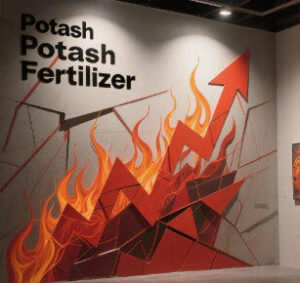
The china potash market is currently displaying a differentiated pattern under the interplay of supply security and price stability policies alongside fundamental factors, characterized by robust potassium chloride performance contrasted with stagnant potassium sulfate conditions.
Potassium Chloride: Tight Supply with Modest Price Fluctuations
The most prominent feature of the current potassium chloride market is supply tightness. Domestic potash production has contracted, with operating rates in Qinghai’s main production areas hovering around 45.5% due to low winter temperatures and planned maintenance, translating to weekly output of approximately 86,000 tons – a 4.5% decrease from the previous period. Factory inventories stand at about 300,000 tons, representing a significant 56.5% year-on-year reduction, further exacerbating supply constraints.
On the import front, arrivals have fallen short of expectations. Although import inventories stand at approximately 2.49 million tons, the high concentration of stock holdings means small and medium traders essentially have “no product available for sale,” resulting in persistently tight market circulation.
Price-wise, the potassium chloride market remains firm. Port prices for 62% white potassium chloride range between RMB 3,150–3,500 per ton, border trade prices for 62% Russian white potassium chloride sit at RMB 3,380–3,400 per ton, and Qinghai 60% white potassium chloride ex-works prices range from RMB 3,100–3,200 per ton. High-concentration 62% imported potassium chloride is particularly scarce, with prices generally trending toward the upper end of ranges.
Potassium Sulfate: Cost-Push Meets Weak Demand
Unlike potassium chloride’s strength, the potassium sulfate market operates steadily but faces a dilemma between high costs and weak demand. Resource-based potassium sulfate prices remain stable, with Xinjiang Luojia 52% powder potassium sulfate delivered prices holding at RMB 3,600 per ton and Qinghai 50% powder potassium sulfate delivered prices stable at RMB 3,500 per ton.
Processed potassium sulfate prices have seen modest increases. Mannheim 50% powder potassium sulfate ex-factory average prices rose by RMB 50 per ton to RMB 3,800 per ton, while 52% powder potassium sulfate ex-factory average prices also increased by RMB 50 per ton to RMB 4,000 per ton.
Cost support remains a key factor for the potassium sulfate market. Sharp increases in raw material potassium chloride and sulfuric acid prices have directly pushed up production costs, providing solid bottom-line support. However, demand-side performance has been disappointing. The operating rate for processed potassium sulfate remains at a low 45%, reflecting significant operational pressure and cautious production attitudes among enterprises. The potassium sulfate market continues seeking equilibrium between cost lines and weak demand, showing notably weaker trends compared to potassium chloride.
Market Outlook: Policy and Fundamentals Seek Balance
Looking ahead, policy intervention will emerge as the key variable shaping market expectations. National supply security and price stability policies have established a “ceiling” for potash prices, limiting disorderly increases. Supported by tight supply-demand fundamentals, potassium chloride is expected to continue fluctuating within high ranges. However, policy restrictions will significantly curb further upward price potential, with markets likely forming new equilibrium points near price ceilings.
The potassium sulfate market will continue receiving cost support, with potential turning points dependent on either potassium chloride price relaxation or improvements in its own supply-demand structure. With potassium chloride prices expected to stabilize under policy supervision, cost support for potassium sulfate will also become relatively clear. After the Spring Festival, as spring plowing fertilizer preparation advances substantively, demand is expected to release moderately, potentially driving modest price stabilization and recovery.
Market participants should currently adopt cautious strategies, navigating rhythms amid fluctuations and avoiding aggressive operations during periods of information ambiguity.
Conclusion
As the spring plowing fertilizer preparation period approaches, downstream compound fertilizer enterprise operating rates show signs of slow recovery. Core market contradictions remain unresolved: potassium chloride maintains strength under rigid supply tightness and cost support, while potassium sulfate continues seeking balance between cost lines and weak demand. Future market direction depends on multiple factors including imported potassium chloride arrivals, progress in downstream compound fertilizer operational rate improvements, and the actual implementation effectiveness of price limit policies.