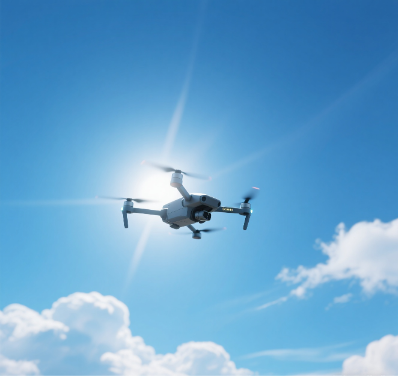
During the 14th Five-Year Plan period, China’s agricultural material and technological equipment conditions have achieved aleapfrog breakthrough. The contribution rate of agricultural scientific and technological progress has surpassed 64%, and the number of agricultural drones nationwide exceeded 300,000 units last year. Intelligent harvesting, irrigation, and laser weeding robots are now entering fields, marking the arrival of a new era of “technology-driven farming” in China’s agricultural sector.
For agricultural input (agrochemical) professionals, the wave of new quality productive forces in agriculture is already breaking on the shore. The second half of the agricultural input industry is no longer about simple products, but about a new capability: “intelligence + service.”
Technology as the New Core
Farming today relies on what flies in the sky, runs on the ground, and is calculated by data. Drones have replaced manual backpack sprayers, covering hundreds of acres per day. Intelligent fertilizer blending equipment precisely formulates based on soil data, moving away from the “one fertilizer fits all fields” approach. AI algorithms, using satellite remote sensing and field sensors, monitor soil moisture and pest and disease conditions in real time, enabling “early detection and early control.” Data, algorithms, and intelligent equipment have become the new core of agricultural inputs. The old “product-selling mentality” is becoming obsolete, and stores that only sell fertilizers and pesticides are being phased out by the market.
How Agricultural Input Enterprises Can Respond
Facing the wave of new quality productive forces in agriculture, agricultural input enterprises can focus their efforts through three key strategies: Transformation, Integration, and Innovation.
1. Transformation: From “General Purpose” to “Intelligently Adapted” Products
In the era of smart agriculture, products must follow intelligent equipment and precise demands.
For example, enterprises should develop specialized aerial application formulations for agricultural drones—highly effective, low-toxicity formulations that address pain points such as low droplet deposition rates, high volatility, and susceptibility to drift. To meet the demands of intelligent fertilizer blending and soil testing-based formula recommendations, they should introduce customized, slow-release, and precision agricultural inputs, achieving “one formula per field.” This is not just a “packaging change,” but a fundamental reconstruction of product logic—making agricultural inputs the “complementary components” of smart agriculture.
2. Integration: From “One-Time Sales” to “Full-Cycle Digital Services”
The core competitiveness of agricultural inputs has never been simply “selling,” but “ensuring effective use.” In the era of new quality productive forces, services must upgrade from “on-site guidance” to “digital full-cycle management.”
This can be achieved by:
-
Partnering with drone companies and agricultural technology firms to establish professional aerial application service teams, providing farmers with one-stop services including “drone plant protection + pest and disease monitoring + effectiveness review.”
-
Building digital agricultural service platforms that integrate data from soil testing, fertilization, sowing, irrigation, and harvesting, offering personalized cultivation plans to farmers.
-
Leveraging the grassroots networks of supply and marketing cooperatives to create a closed loop of “online platform + offline service stations,” allowing farmers to “find products, book services, and check data” all from their mobile phones.
The goal is no longer to “sell agricultural inputs,” but to sell “agricultural solutions,” transforming agricultural input enterprises from “product suppliers” into “farm managers” for farmers.
3. Innovation: From “Offline Solo Efforts” to “Digital and Intelligent Ecosystem Co-creation”
The era of going it alone is over. The core of new quality productive forces is “collaborative innovation.” Agricultural input enterprises need to build digital and intelligent ecosystems.
This can involve:
-
Collaborating with agricultural research institutions on the coordinated development of improved seeds, intelligent equipment, and new agricultural input materials, avoiding “pseudo-innovation” and achieving true technological iteration.
-
Co-creating digital demonstration fields with agricultural input distributors and large-scale farmers, using real planting and yield data to validate the effectiveness of new quality productive forces models.
-
Leveraging big data analytics to accurately predict market demand, optimize inventory, and reduce costs, making enterprise operations more efficient.
Such an ecosystem is not simply “cooperation,” but “resource sharing, risk sharing, and mutual benefit,” guiding the agricultural input industry from fragmented competition toward coordinated development.
Conclusion
In the past, agricultural inputs were the tangible fertilizers and pesticides. Now, data, algorithms, and intelligent equipment have become the new core of the industry. Enterprises that cling to the old “product-selling” mindset will eventually face market elimination. Those that can keep pace with the rhythm of new quality productive forces will become the “navigators” of the industry.