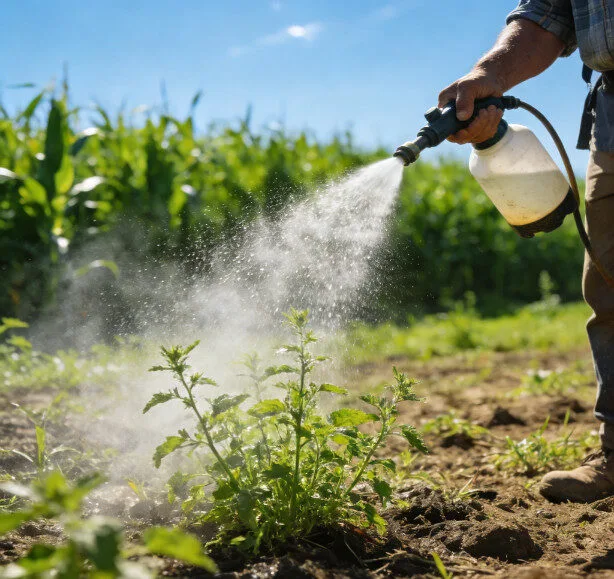
The global agrochemical market is witnessing a striking anomaly. Amidst widespread softness in crop protection product demand due to low agricultural commodity prices, glufosinate, a non-selective herbicide, is experiencing a remarkable surge. In the second half of 2025, glufosinate technical demand in China skyrocketed by over 50% year-on-year, while industry inventories plunged to historical lows and operating rates consistently exceeded 90%. This article delves into the multifaceted drivers behind glufosinate’s “counter-cyclical boom,” analyzing its short-term dynamics, long-term substitution logic, and evolving competitive landscape.
I. Short-Term Dynamics: A Mirage of Oversupply vs. Reality of Tight Balance
Superficially, the market exhibits a structurally oversupplied characteristic due to new capacity releases. However, the core tension lies on the demand side. A significant decline in global prices for staple crops (wheat, corn, rice) in 2025 has squeezed farm incomes, heightening sensitivity to input costs and creating downward pressure on procurement prices for pesticides like glufosinate. A similar cost-control mindset prevails in China’s cash crop sector.
Contrary to the oversupply narrative, key indicators reveal a tight supply-demand balance. Factory inventories of glufosinate technical reached historical lows in Oct-Nov 2025, and operating rates remained above 90%. This paradox is explained by the nature of demand growth: it stems largely from inelastic agricultural necessity and the ongoing replacement of older herbicides, rather than discretionary spending. Consequently, prices are currently shaped by a tug-of-war between cost support and demand-side price pressure, with significant volatility deemed unlikely in the near term.
II. The Core Engine: Long-Term Substitution Logic in High Gear
The sustained growth trajectory of glufosinate is fundamentally powered by its robust substitution narrative against two major herbicides:
-
Glyphosate Replacement: Glyphosate faces dual headwinds: increasing weed resistance issues eroding its efficacy, and ongoing litigation (notably involving Bayer) over alleged carcinogenic effects, which has damaged market confidence.
-
Paraquat Vacuum: The high toxicity of paraquat has led to its phased withdrawal from major markets globally, creating substantial demand for safer, effective alternatives.
Glufosinate is capitalizing on this opportunity. Its action mechanism offers complementary benefits to glyphosate. Furthermore, continuous process upgrades, particularly the iteration towards high-purity L-glufosinate (often called “精草” or “glufosinate-P”), are optimizing production costs, thereby strengthening its competitive and substitution advantage. The market is shifting away from a perception of chronic oversupply, recognizing that demand increments are driven by solid agricultural fundamentals and the rollout of glufosinate-tolerant genetically modified (GM) crops.
III. Regulatory Tailwinds: The “One Product, One Certificate” Policy
A pivotal factor reshaping China’s glufosinate market is the “One Product, One Certificate” policy, expected to be fully enforced around mid-2026. This mandates that technical material manufacturers must hold the registration certificate for production, effectively curbing the common practice among formulation companies of “borrowing” certificates for market access.
While this policy does not directly stimulate product demand, it profoundly optimizes market structure. It will accelerate industry consolidation by favoring large, compliant players with established registration portfolios, extensive sales networks, and strong promotion capabilities. Small and medium-sized enterprises (SMEs) relying on non-compliant channels will face intensified competition and pressure. Long-term, the policy promotes market standardization, reduces cut-throat price competition, and supports profitability stability for leading companies.
IV. Evolving Supply Structure and Cost Dynamics
China’s glufosinate capacity is concentrated among key players. Frontrunners like Inner Mongolia Mingsheng (under Hebei Chengxin) and Shandong Yisheng (in partnership with Jiangsu Yangnong) command a combined capacity nearing 100,000 tons. Other producers (e.g., Yongnong, Weiyuan, Fuhua, Lier) typically have capacities ranging from 10,000 to 20,000 tons.
The cost curve is distinctly stratified. Leading enterprises leverage economies of scale to maintain costs between 40,000-45,000 RMB/ton, allowing for break-even or marginal profits. In contrast, some SMEs with smaller capacities face costs approaching 50,000 RMB/ton, leading to production losses (cost-price inversion) and reduced output. An upcoming cost push may come from the potential enforcement in 2026 of a new chloride ion limit standard for glufosinate formulations, which would increase wastewater treatment costs.
V. The Rise of Glufosinate-P and International Ambitions
Glufosinate-P is becoming a major growth vector, rapidly replacing traditional glufosinate formulations in the domestic market; substitution rates exceeded 50% among leading formulators in 2025. Its per-hectare application cost has become comparable to or even lower than glyphosate, offering compelling (cost-performance).
Major domestic producers of Glufosinate-P include Sichuan Lier, Zhejiang Yongnong, Inner Mongolia Mingsheng (new 20,000-ton facility in 2025), and Zhejiang Xinan (primarily for internal conversion). The dominant production route is the bio-inorganic amination method.
On the global stage, Chinese companies are aggressively pursuing international registrations for Glufosinate-P. Its superior cost-performance is enabling it to gradually replace products from multinational giants. While companies like BASF may view this trend cautiously, the global substitution wave appears irreversible. Overseas order negotiations in Q2 2026 are anticipated to be a key demand growth point.
VI. Future Outlook: Sustained Growth Amidst Rationalization
Looking ahead, glufosinate demand is expected to maintain robust growth, supported by:
-
Seasonal Strength and GM Traction: Demand peaks during spring/summer weeding seasons. The adoption of glufosinate-tolerant GM crops (with 10 and 9 companies registered for soybean and corn in China, respectively) is expanding application scenarios.
-
Limited New Capacity: New projects for both glufosinate and Glufosinate-P are limited due to current cost pressures and stricter environmental standards, constraining supply growth.
-
Market Rationalization: The “One Product, One Certificate” policy will foster a healthier competitive environment.
In conclusion, glufosinate’s “counter-cyclical” is not a flash in the pan but a convergence of powerful structural trends: irreversible substitution, product innovation (Glufosinate-P), regulatory-driven consolidation, and strategic global expansion. As the market matures and rationalizes, glufosinate is poised to solidify its position as a pillar of modern weed management.