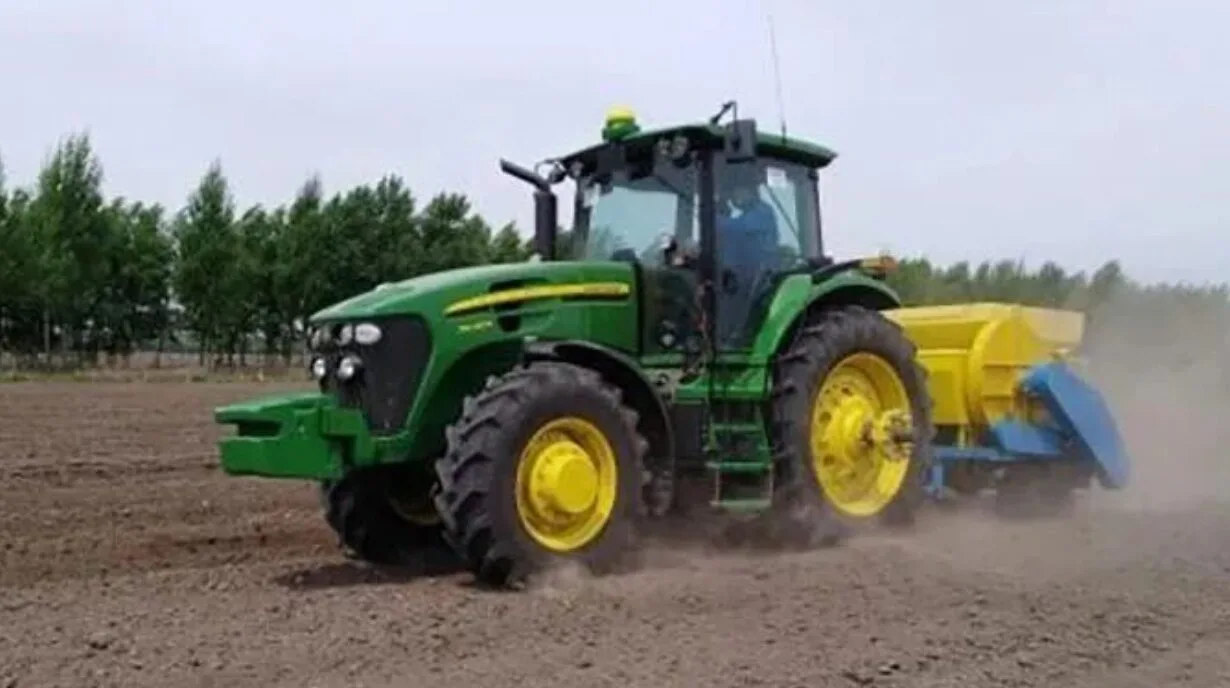
Data shows that from January to November 2025, China exported a total of 167,400 tractors, a year-on-year increase of 20.2%, with a cumulative export value of $801.3 million, surging by 32.1%. This indicates robust international demand for Chinese tractor products. Here we discuss the sixth major trend for 2026: the simultaneous growth in quantity and enhancement in quality of agricultural machinery exports.
1. Overall Characteristics of Agricultural Machinery Exports in 2025
Overall, China’s agricultural machinery exports in 2025 maintained scale growth, witnessed continuous optimization of the product mix, and saw further diversification of export markets.
First, export scale expanded. Based on comprehensive annual data, the total export value for 2025 is expected to maintain double-digit growth, reaching approximately $17 billion, an increase of over 10%.
Second, export markets diversified. Countries along the “Belt and Road” initiative have become the primary export destinations, accounting for over 60% of exports. Among them, the African market grew the fastest, with a year-on-year increase of 46.6%. In the European market, Chinese agricultural machinery made breakthroughs in sectors like gardening machinery and specialized equipment, with significant export growth to countries such as Germany, where exports rose by 67.27% year-on-year.
Third, product structure upgraded, with a rising share of high-end products. Specialized products experienced rapid growth: exports of items like cotton harvesters, poultry farming equipment, and lawn mowers saw outstanding increases, with some products soaring by over 700%. This reflects the enhanced competitiveness of Chinese agricultural machinery in niche segments.
Fourth, enterprises deepened their international presence. Leading companies such as YTO Group and Weichai Lovol accelerated the construction of overseas channels, improving their international market responsiveness by establishing overseas service networks and engaging in local partnerships.
Thus, China’s agricultural machinery exports are transitioning from being “price-driven” to “performance and value-driven,” entering a new stage of high-quality development.
2. Trend Towards Larger and Higher-End Tractors for Export
The 32.1% increase in the export value of tractors in 2025, which is 11.9 percentage points higher than the 20.2% growth in volume, indicates an improvement in the quality and performance of exported tractors. The proportion of high-end products such as large tractors over 100 horsepower, intelligent agricultural equipment, and new energy agricultural machinery has increased significantly. Technologies like power shift, continuously variable transmission, and intelligent control are being progressively adopted. As China’s large tractors, especially new energy intelligent tractors, gradually mature, they will soon become popular in the domestic market and also enter foreign markets, competing in the international arena for large, high-end tractors.
3. Obvious Export Advantages of Agricultural Machinery Industrial Clusters
China’s agricultural machinery exports are typically concentrated in industrial cluster regions. For example, in the first 11 months of 2025, the total export value of agricultural machinery from Hunan Province reached 670 million RMB, a year-on-year increase of 76.3%, far exceeding the national average growth rate. Changsha and Loudi together accounted for over 80% of this total, with Loudi being a hub for small agricultural machinery manufacturing in Hunan, making it a major export region.
In industrial clusters like Taizhou, Zhejiang, new channels such as cross-border e-commerce provide more accessible pathways for small and medium-sized enterprises to go global. Taizhou, known as the “Capital of China’s Plant Protection and Cleaning Machinery,” has formed a complete industrial and supply chain covering parts production, complete machine assembly, and sales services. The cluster effect reduces costs, enhances collaborative innovation capabilities, and fosters international competitiveness in segments like sprayers through a “cluster-based globalization” model.
The Chongqing industrial cluster focuses on equipment for hilly and mountainous areas, such as micro-tillers and small agricultural machinery. Its export market is primarily Southeast Asian countries, where it has established multiple production bases.
4. Chinese Cities with Concentrated Agricultural Machinery Exports
Provinces with a high share of agricultural machinery exports include Jiangsu, Zhejiang, and Shandong. The main cities, their primary export varieties, and target countries are as follows:
-
Jiangsu: Changzhou mainly exports lawn mowers and tillage machinery to Europe and Southeast Asia; Suzhou exports sprayers, seeders, and other small to medium-sized machinery to India and Thailand; Nanjing exports large tractors and combine harvesters to countries like Russia and Brazil.
-
Zhejiang: Jinhua primarily exports walking tractors, micro-tillers, and mountain weeders to Europe, America, and Southeast Asia; Hangzhou exports high-end equipment like intelligent lawn mowers and fruit sorters to Africa and the Middle East; Wenzhou exports agricultural machinery parts and small agricultural vehicles worldwide.
-
Shandong: Driven by major manufacturers in Weifang, it is a concentrated production base for exporting tractors and combine harvesters, mainly to Southeast Asia and South America; Qingdao, a port city, mainly exports crawler tractors and hay machinery to Central Asia and Africa; Linyi exports large quantities of tillage machinery and sprayers to countries like India and Pakistan.
-
Henan: Luoyang, driven by major tractor factories, accounts for 40% of the province’s tractor export value, mainly shipping to African and Southeast Asian countries; Zhengzhou exports more oil processing machinery and livestock farming equipment, covering markets in South America and the Middle East.
-
Xinjiang: Urumqi and other areas mainly export cotton harvesters.
5. The Major Trend for 2026: Growth in Export Volume Coupled with Quality Improvement
In recent years, the globalization of Chinese agricultural machinery has gradually become a trend. Relevant industry associations organize exhibitions abroad and facilitate visits to major international agricultural machinery trade shows. Domestic enterprises actively participate in the Canton Fair and the China-ASEAN Expo in Nanning to explore export opportunities. The increase in routes and frequency of China-Europe Railway Express services has also significantly promoted international exchanges in agricultural machinery, boosting product exports and facilitating companies’ expansion overseas.
With the ongoing upgrading of China’s agricultural machinery and the enhanced brand awareness among exporting enterprises—shifting from merely exporting products to building brands—it is believed that in 2026, the volume of China’s agricultural machinery exports will continue to grow, while product quality and technological content will see even greater improvement.