
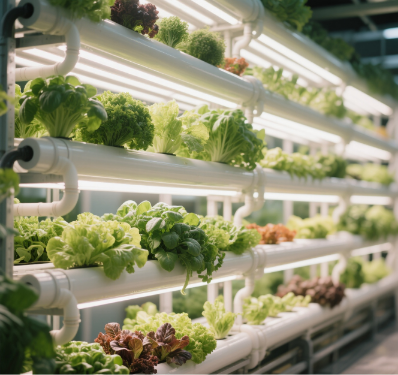
The “ecology + circularity” development model can drive the unification of economic, social, and ecological benefits. It aligns with contemporary industrial development philosophies and promotes sustainable agricultural production. This approach involves tailoring operations to local conditions, leveraging local ecological resources to establish independent and mature single or multiple composite agricultural modules. It fully capitalizes on the advantage of vast resources, not only rooting itself in the improvement of the local ecological environment but also enabling cross-regional resource allocation, thereby forming a modern ecological circular agriculture system within a broader spatial context.
Development Focus of Ecological Circular Agriculture
1. Cultivating Interdisciplinary Talent
Ecological circular agriculture is a high-tech industry where talent is indispensable. Professionals knowledgeable in ecology, agriculture, and the internet are particularly crucial. Integrating the fundamental theories of ecological circular agriculture, the efficient use of agricultural resources, the protection of production environments, and the enhancement of ecological service functions into agricultural talent training is essential. Emphasis should be placed on cultivating agricultural management entities at different levels, guiding them to actively implement ecological circular practices in their innovation and entrepreneurship endeavors, thereby continuously advancing green agricultural development.
2. Capitalizing Ecological Circular Agriculture Projects
Investing in an ecological circular agriculture project can range from over 100,000 RMB to several million RMB. However, similar to other agricultural projects, it faces the dilemma of “high investment, slow returns.” This scale of investment is challenging for most enterprises, let alone individual farmers. While China is promoting Public-Private Partnerships (PPP) in the agricultural sector, attracting capital, especially commercial capital, to ecological circular agriculture remains a critical challenge.
3. Refining the Business Model
While each segment of circular agriculture can be profitable, which segment should be the primary driver? What aspect should the overall ecological circular agriculture system rely on for profitability? Refining the business model requires top-level design. It should center on ecology, consider every aspect of agriculture, and design a viable profit model. Simultaneously, established business models should be replicable to accelerate the monetization potential of ecological circular agriculture projects.
4. Industrialization
Although ecological circular agriculture appears to be an integrated industrial chain, its industrialization remains relatively weak. The core challenge lies in how to build the central industry and how to use it to drive improvement in other segments. The goal of ecological circular agriculture is not ecology or circularity for their own sake but rather to enhance integration and resource utilization efficiency based on solid industries.
5. Innovation as the Key
In China, ecological circular agriculture has been developing for many years, yet it has not become a dominant force in Chinese agriculture. Breaking the deadlock in ecological circular agriculture still relies on innovation: technological innovation, talent innovation, and business model innovation.
Development Models of Ecological Circular Agriculture
1. Material Reuse Model
This involves the multi-level recycling of agricultural waste, using the waste or by-products of one industry as raw materials for the next, such as the utilization of biogas and livestock manure.
2. Straw-Centric Circular Models
Promoting straw return to fields can effectively achieve the ecological cycle goals of reducing emissions from burning and enhancing soil fertility. Beyond this, there are various straw-centric agricultural circular models, such as building industrial chains around comprehensive straw use for feed, fuel, and substrate, e.g., “straw – substrate – edible fungi,” “straw – processed fuel – fuel – households,” and “straw – silage feed – livestock farming.”
Through the improvement of agricultural infrastructure, production conditions, and the environment are enhanced. Combining crop farming with animal husbandry enables the resourceful recycling of agricultural waste, eliminating environmental pollution from waste and improving land and water quality. This has positive significance for promoting the sustainable use of agricultural resources, advancing coordinated governance of water systems (“five-water co-governance”), and beautifying rural environments.
This model enables the graded resource utilization of straw and zero pollutant emissions, allowing for the rational and effective use of straw waste resources. It addresses the environmental pollution and resource waste caused by random discarding or burning of straw while yielding organic fertilizers, clean energy, and biological substrates.
3. Reduction-Oriented Model
This model standardizes the use of chemical fertilizers, pesticides, veterinary drugs, feed, and additives, and promotes technologies like formula fertilization based on soil testing and green pest control to improve the efficiency of fertilizer and pesticide use.
4. Resource Recovery Model
For example, “Permaculture” is an important form of waste resource recovery within the circular economy. It focuses on maximizing beneficial relationships through effective element configuration while conserving resources and not harming the environment. Practitioners recycle various resources and save energy, such as using swales to harvest rainwater, converting manure into organic fertilizer, and implementing straw return. Permaculture seeks to use land resources as sparingly as possible, emphasizing the use of perennial plants and encouraging self-regulating systems. When cultivating land, techniques like polyculture and green cover crops are used to maintain soil health, monitor the local environment, and formulate green development plans. Permaculture avoids synthetic fertilizers and pesticides, instead deterring pests by planting diverse species and attracting predators into the ecosystem. For instance, leguminous plants like alfalfa release nitrogen and can disorient pests.
5. Eco-Industrial Park Model
The scale of circular agriculture encompasses three levels: departmental, regional, and societal. The departmental level mainly refers to a single enterprise or farm household as a circular unit. The societal level implies a “circular rural society.” At the regional scale, following ecological principles, material, energy, and information integration among enterprises forms an eco-industrial park driven by leading enterprises and containing several small and medium-sized enterprises and farm households. The Maya Farm in the Philippines is a successful example of an eco-industrial park.
In the view of Agricultural Industry Observation, ecological circular agriculture is also a systematic industrial model. Beyond circular economy models, it requires agricultural industrial chain models and agricultural food chain models. In the future, finding new opportunities and new business avenues within the “ecological circular agriculture” model will be the more crucial breakthrough.