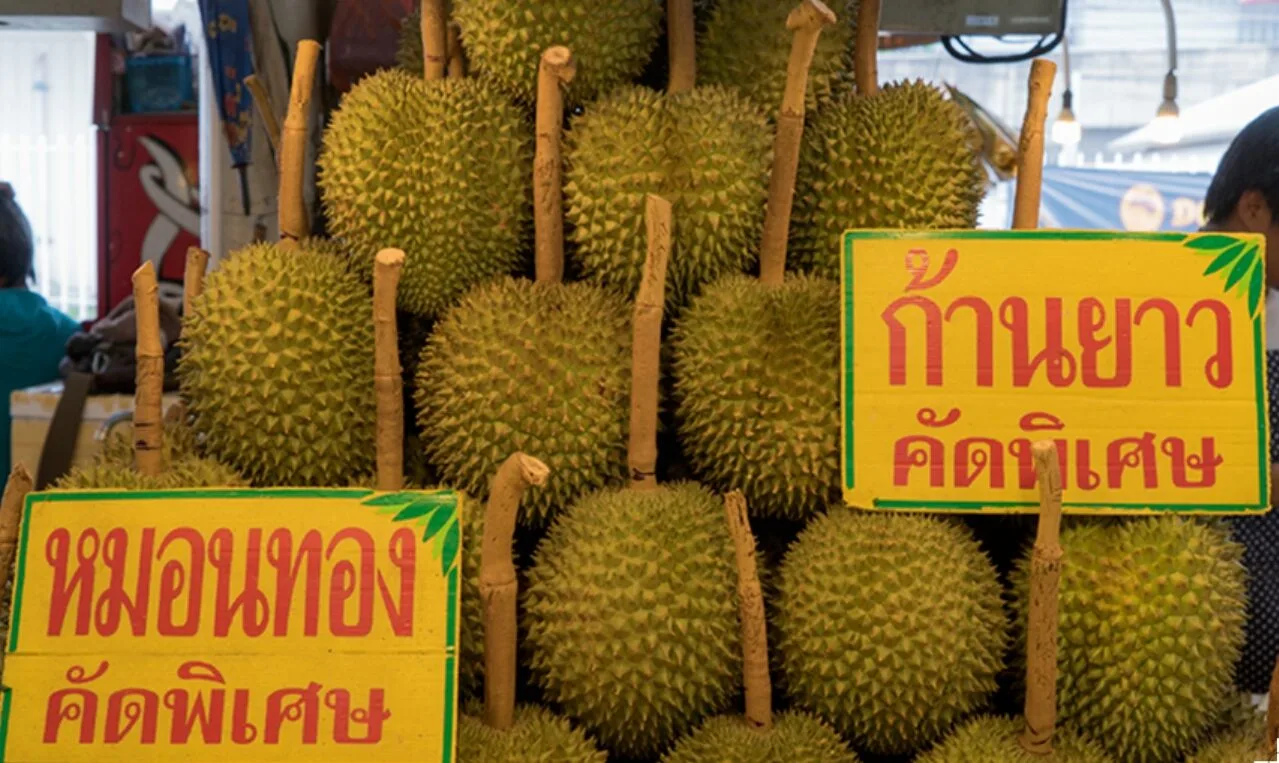
Bangkok, January 10, 2026 – According to a recent evaluation report released by Kasikorn Research Center (K-Research), Thailand’s durian prices have been declining for five consecutive years. In 2025, the overall price dropped by 16% to 92.5 Thai Baht per kilogram (approximately RMB 20.63), significantly lower than the average price of 108.7 Baht per kilogram recorded between 2019 and 2024. Analysts attribute the price decline primarily to increased production and intensified competition in the Chinese market. It is projected that Thai durian prices will continue to fall in 2026, potentially stabilizing around 90 Baht per kilogram. In the future, Thailand’s durian may bid farewell to the “era of high prices,” with a return to levels above 100 Baht per kilogram unlikely.
K-Research say that competition in China’s durian market is intensifying, leading to a gradual decline in Thailand’s competitiveness. Notably, Vietnam, a major competitor, has gained approval to export fresh durians to China starting in 2025 and has made significant inroads in the Chinese market. Coupled with Vietnam’s own development, its exports have surged, achieving a leap in market share, which has led to a gradual decline in Thailand’s market share in China. Additionally, emerging competitors such as the Philippines (2026), Malaysia (2027), and Cambodia and Laos (2028) are entering the market. It is estimated that in 2026, Thailand’s export value of fresh durians will decrease by 1.8% to $3.705 billion.
Although Thai durians currently maintain the top market share in China due to their superior quality and unique flavor, Vietnam holds clear advantages in terms of lower costs and shorter transportation distances.
The study points out that four provinces in China import durians simultaneously from both Thailand and Vietnam: Guangdong, Yunnan, Zhejiang, and Guangxi. Among these, Guangdong, Yunnan, and Zhejiang show more prominent growth. These provinces import higher quantities of fresh durians from Thailand compared to Vietnam and are high-income, high-population-density regions, making them important markets that Thailand strives to maintain.
A greater challenge lies in Guangxi Province. Data shows that Guangxi’s import value of durians from Thailand is lower than that from Vietnam. Due to geographical proximity, the more affordable Vietnamese durians are better positioned to capture the local market.
Of particular note is Sichuan Province. Although its imports of fresh durians from Thailand amount to only $233 million, the value is nearly 130% higher than imports from Vietnam, making it an important potential export market for Thailand.
For a long time, Thailand’s durians enjoyed a preference in the Chinese market, driving prices as high as 150–200 Baht per kilogram. However, this year, durian prices are expected to remain around 90 Baht per kilogram, the lowest level in nearly six years.
In terms of production, due to an increase in durian cultivation area and favorable weather conditions for flowering and fruiting, the Thai Office of Agricultural Economics forecasts that durian production in 2026 will reach 1,781,019 tons, a 16% increase compared to 2025.
In response, the Thai Office of Agricultural Economics has issued a warning, urging Thai durian exporters to enhance product quality to “win with quality,” improve supply chain reliability, and maintain durian freshness to consolidate their position in the high-end market. This is essential to address increasingly stringent Chinese quarantine regulations and the intensifying competition from regional rivals.