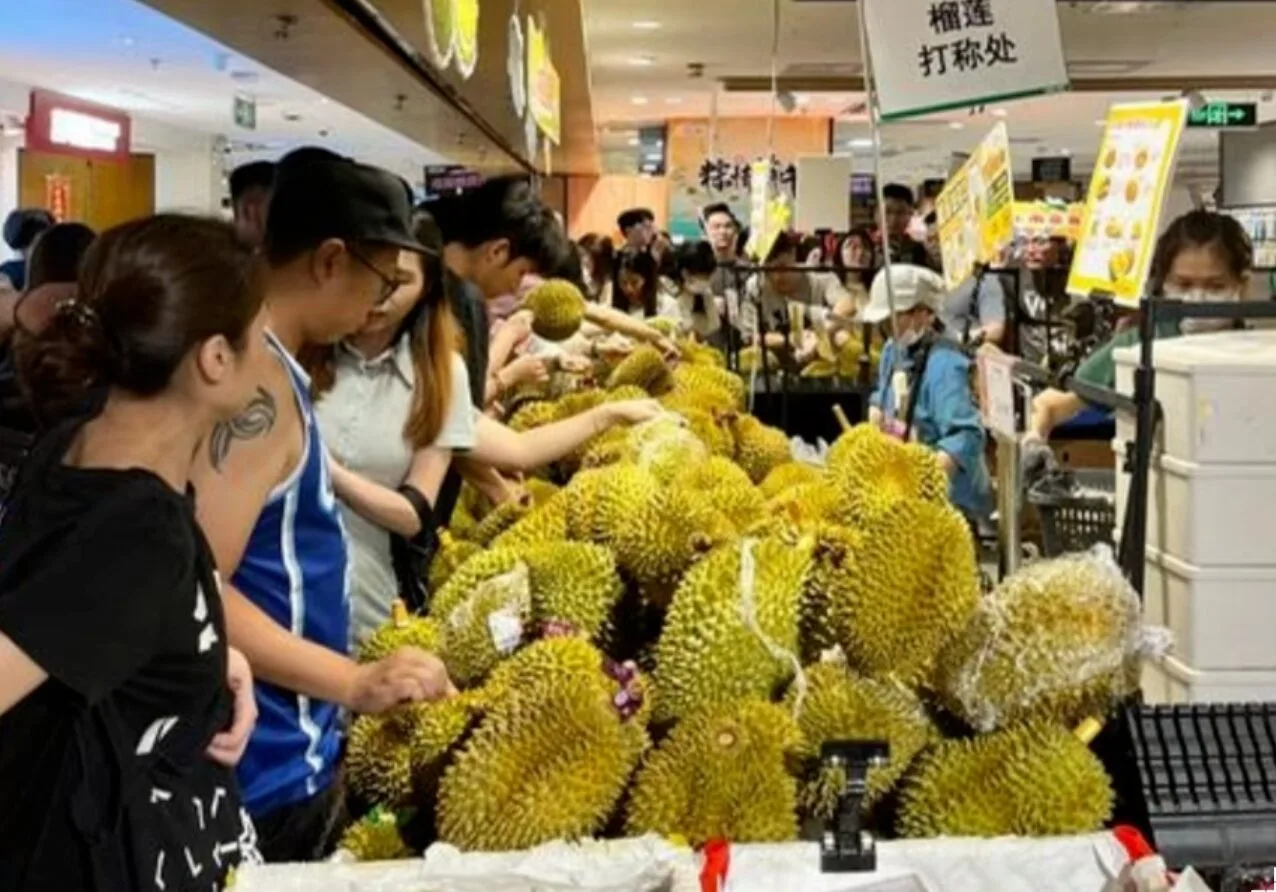
The official launch of island-wide customs closure operations in the Hainan Free Trade Port has been marked by viral reports of a dramatic plunge in durian prices. News emerged that on the first day of the new regime, a batch of 1.5 tons of premium Malaysian Musang King durians arrived in Haikou for retail sale, with prices slashed to 78-98 yuan per jin (approximately 500 grams), nearly half of the usual market rate, drawing large crowds of eager consumers.
At the Wanghao supermarket in Haikou’s Longhu Tianjie complex, a winding queue reportedly stretched for over a hundred meters, reaching the roadside. Some shoppers arrived four hours early, bringing their own stools to secure a spot. Within just one hour of the sale starting at noon, the entire 1.5-ton stock was sold out.
However, follow-up investigations by reporters in Sanya revealed a more nuanced picture. At most supermarkets in the city, prices for imported durians have not seen a widespread decline. Consumers at general retail outlets still cannot purchase truly “duty-free” durians.
According to a joint policy notice from the Ministry of Finance, the General Administration of Customs, and the State Taxation Administration on goods movement across Hainan’s “frontline” (with overseas), “second-line” (with mainland China), and within the island, the current “zero-tariff” import policy primarily targets eligible, registered beneficiary enterprises. These enterprises can import goods not on a “negative list” exempt from import duties, import VAT, and consumption tax. These “zero-tariff” goods can also circulate between beneficiary enterprises without tax replenishment. However, if an enterprise sells such goods to a non-beneficiary enterprise, an entity outside Hainan, or an individual consumer, the corresponding import taxes must be paid.
This means that “zero-tariff” goods must have their tax obligations settled before entering the personal consumption chain. Therefore, goods sold in regular supermarkets already include these taxes in their price.
Consequently, the reported “halving” of Musang King durian prices is not a direct result of the “zero-tariff” policy itself. Industry insiders attribute it mainly to improved logistics efficiency, reduced warehousing costs, and promotional discounts offered by enterprises following the customs closure. They point out that post-closure, goods entering Hainan from overseas are exempt from tariffs and import taxes, cutting nearly 30% of costs. Furthermore, leveraging the “direct release” policy, the number of required data entries for declaration has been streamlined from 105 to 33, reducing overall customs clearance time to under two hours and lowering spoilage rates to around 5%.
In a related development, Sanya Daily reported that in the early hours of November 28th, another shipment of fresh durians from Malaysia and Thailand arrived in Sanya. The batch, totaling over 1,600 kg, included popular varieties like Golden Pillow, Black Thorn, and Musang King, as well as niche Malaysian varieties like “Zhu Jiao.” Reported prices were 78 yuan per jin for Musang King and Black Thorn, and 58 yuan per jin for Golden Pillow.
The report highlighted that the special customs supervision model of “frontline liberalization, second-line control, and free flow within the island,” implemented post-closure, reduced intermediate links. This enables a more efficient supply chain from orchard to store, significantly lowering logistics costs and enhancing both the freshness and price competitiveness of the durians.
For consumers wishing to purchase genuinely duty-free goods, the existing “Duty-Free Shopping for Departing Passengers” policy remains the channel. This requires shopping at airport or downtown duty-free stores and physically carrying the goods off the island. It was reported that in the first six days following the customs closure, four duty-free stores in Sanya achieved cumulative sales of 630 million yuan, a year-on-year increase of 47.2%, with daily sales exceeding 100 million yuan.