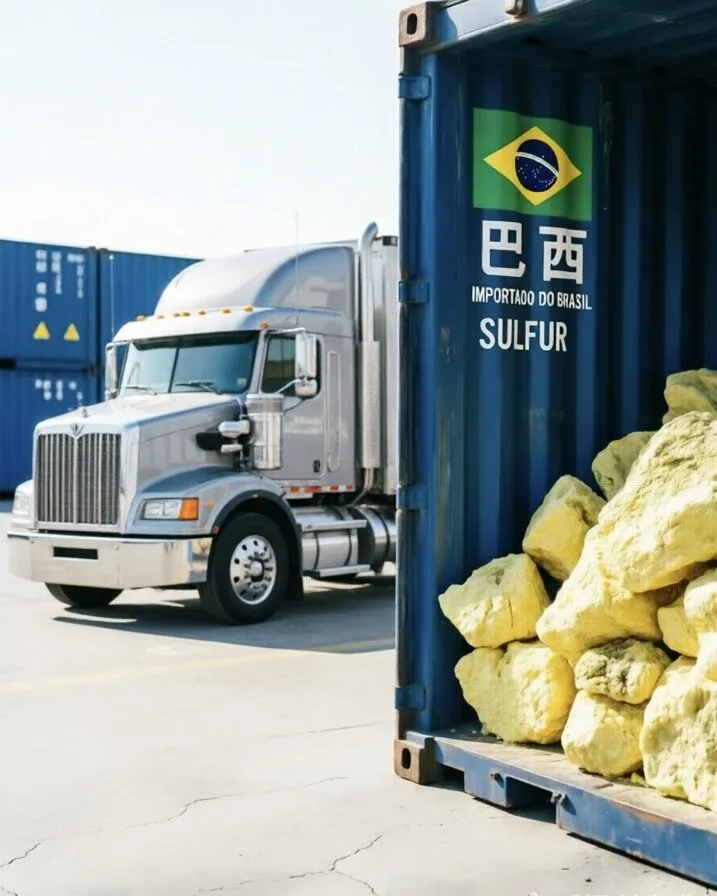
Brazil’s sulfur imports collapsed to their lowest monthly level in 21 years this May, according to the latest data from the Global Trade Tracker (GTT). Shipments totaled just 59,090 metric tons, a staggering 72% drop from the same month in 2025—and the smallest volume recorded since 2005.
The sharp contraction reflects a combination of tight global supply and historically high sulfur prices, which have discouraged spot purchases. Turkmenistan supplied 53.5% of May’s total, followed by the United States (34%) and Turkey (10%).
The first five months of 2026 tell a similarly bleak story. Cumulative sulfur imports reached 630,090 metric tons, down nearly 46% year‑on‑year and marking the lowest January–May total since 2009. Kazakhstan ranked as the top supplier for the period with 39%, followed by the U.S. (22%), Turkmenistan (14%) and India (8.8%).
Sulfuric acid imports surge
In contrast, Brazilian buyers turned aggressively to sulfuric acid—a key substitute in phosphate processing. May imports of sulfuric acid more than doubled year‑on‑year to 79,790 metric tons, the highest monthly figure since 2022. Spain (35%), Finland (25%), Italy (24%) and South Korea (15%) led shipments.
Over the first five months, sulfuric acid imports jumped 69% to 323,005 metric tons. Belgium was the largest origin (33%), followed by Spain (22.5%), Italy (18%), Finland (16.5%) and Turkey (5.8%).
Fertilizer arrivals up, but domestic production falls
Despite the sulfur squeeze, Brazil’s overall fertilizer logistics remained resilient in the first quarter. The country’s fertilizer arrival total—covering imports and domestic deliveries—reached 9.76 million metric tons in Q1 2026, up 3.8% from 9.40 million tons in Q1 2025, according to the Brazilian Fertilizer Distribution Association (ANDA). March arrivals alone surged 18.7% year‑on‑year to 2.83 million tons.
Mato Grosso, Brazil’s top fertilizer-consuming state, received 2.45 million tons in Q1—more than a quarter of the national total. It was followed by Goiás (1.10 million), São Paulo (1.08 million), Paraná (1.02 million), Minas Gerais (882,000), Mato Grosso do Sul (543,000) and Bahia (541,000).
However, domestic intermediate fertilizer production weakened. ANDA reported Q1 output of 1.41 million tons, down 16.2% from 1.68 million tons a year earlier. March production fell 9.7% to 483,000 tons. The association noted that data collection remains incomplete due to corporate restructuring and the restart of some production units, meaning actual capacity utilization may be slightly understated.
Imports and port trends
Intermediate fertilizer imports in Q1 totaled 8.15 million tons, a 4% decline from 8.49 million tons in Q1 2025. March imports, however, rose 10.1% to 2.74 million tons. The port of Paranaguá—the country’s main gateway for fertilizers—handled 2.12 million tons in Q1, down 13.5% from 2.45 million tons a year earlier. Still, it accounted for 26.1% of all fertilizer imports by sea during the period.
Outlook
The sulfur crunch comes at a critical moment for Brazil’s farm sector, as the country gears up for the second‑season corn and upcoming soybean planting. With global sulfur markets remaining tight and prices elevated, buyers are likely to continue substituting with sulfuric acid where possible, while domestic producers may face margin pressure. ANDA’s full‑year arrival forecast, originally set at 43 million tons, could be revised if sulfur shortages persist and constrain phosphate fertilizer output.
For now, the stark divergence between sulfur’s collapse and sulfuric acid’s boom underscores how Brazilian importers are adapting to a transformed global nutrient market—one where availability and cost are forcing rapid shifts in sourcing strategies.