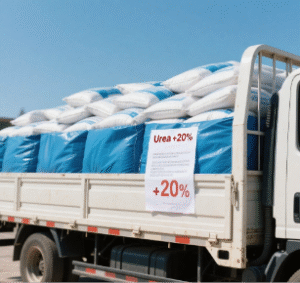
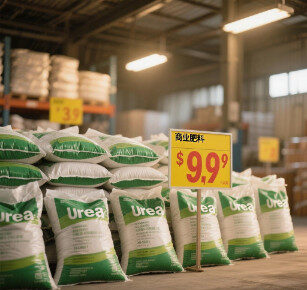
Urea prices in major Chinese regions posted broad-based gains this week, with mainstream ex-works quotations for small and medium granular material ranging between RMB 1,750–1,850/ton, according to market data for June 18.
Supply Side: High Output Persists
Despite maintenance turnarounds at some production facilities, China’s daily urea output remains elevated at approximately 210,000 tons, with operating rates around 90%. Supply remains ample, and producer inventories have continued to accumulate.
Demand Side: Seasonal Pickup, but Not Yet Peak
Agricultural demand has shown modest improvement, with grassroots fertilizer stocking sentiment strengthening. However, the peak summer application season has not yet arrived, and demand release remains limited and concentrated.
Compound fertilizer producers are purchasing on a strict as-needed basis, while other industrial consumption has shown no significant growth. Export quota allocations remain limited, exerting minimal impact on the domestic supply-demand balance.
Price Outlook: Cautiously Optimistic
Looking ahead, the upward adjustment of urea guidance prices, combined with rising coal and natural gas feedstock costs, is expected to lend support to urea prices. The third quarter is likely to see stable-to-higher urea prices.
However, several factors will continue to cap upside potential:
-
Sustained high daily production
-
Lackluster industrial demand
-
Continued export restrictions
The oversupply situation in the domestic market is unlikely to reverse fundamentally in the short term, suggesting any price increases will remain moderate in magnitude.
Regional Ex-works Quotations (June 18, 2026)
Small/mid granules unless otherwise noted; prices in RMB/ton; changes vs. previous session
| Region | Price Range | Change |
|---|---|---|
| Shandong | 1,780–1,810 | ↑20 |
| —Linyi delivered | ~1,840 | — |
| —Heze delivered | ~1,830 | — |
| —Large granules | ~1,870 | — |
| Henan | 1,780–1,800 | ↑10–20 |
| Hebei | 1,780–1,800 | ↑20 |
| —Large granules | ~1,920 | — |
| Anhui | 1,780–1,800 | ↑10 |
| Jiangsu | 1,810–1,850 | ↑20 |
| —Large granules | ~1,900 | — |
| Hubei | 1,750–1,760 | ↑10–20 |
| Hunan (market price) | 1,820–1,850 | ↑20 |
| Jiangxi | ~1,830 | ↑40 |
| Shanxi | 1,680–1,750 | ↑20 |
| —Large granules | ~1,780 | — |
| Shaanxi | ~1,720 | ↑40 |
| Gansu | ~1,740 | — |
| Ningxia | ~1,620 | — |
| Inner Mongolia | 1,680–1,720 | — |
| Xinjiang | 1,490–1,690 | — |
| Guangxi (market price) | 1,900–1,910 | — |
| Guangdong (market price) | 1,930–1,940 | — |
| Fujian (delivered) | 1,900–1,920 | — |
| Sichuan | 1,800–1,830 | — |
| Chongqing | ~1,800 | — |
| Yunnan | 1,940–2,100 | ↑40 |
| Guizhou | ~1,850 | — |
| Heilongjiang | ~1,900 | — |
| Jilin | ~1,870 | — |
| Liaoning | ~1,850 | — |
Summary
The domestic urea market showed broad resilience with regional increases ranging from RMB 10–40/ton. The strongest gains were seen in Jiangxi and Shaanxi (both +40), while Yunnan (+40) also posted notable increases. Northern and western regions held steady. Market participants will be watching upcoming summer application demand and any policy signals on export quotas to gauge the sustainability of the current uptrend.